This page covers the content used for a CPD session delivered to CENA umpires on 6 October 2026. The session focused on contact vs contest and game management, along with a canter through some frequently confused rules.
Each section includes a range of clips showing different scenarios. Most come from elite-level netball, with some from Scottish National League matches — keep that in mind when judging the skill level of the players and the standard of play, and when thinking about how this applies in our local league. A few of the clips come from matches played under the 2020 rules, but as we go through the session we should judge everything against the 2024 rules.
Finally, the umpires in these clips won't have got every decision right — umpires make mistakes like anyone else. Where a clip shows the on-court call, that isn't us saying the umpire was right or wrong: judge each scenario on its own merits.
Contact or contest
Netball is a contested sport, so players will come into contact with each other. Not every instance of contact is an infringement — contact only becomes an infringement when it interferes:
- the opponent loses possession of the ball,
- their passing or shooting action is interfered with, or
- their position is changed in a way that limits their free movement.
A helpful question to ask yourself
Would the player's position or action be meaningfully different without the contact?
If the action wouldn't be different, you shouldn't be penalising it.
A full discussion of contact can be found on the Rule 17 page.
Make the call
No whistle — play on.
There's contact between the attacking C and the defending WD, but it doesn't interfere: the C catches the ball on balance and is still in the same position to play it from the circle edge. The contact hasn't affected her ability to play the ball, so there's nothing to penalise.
Rule 17 — contact and the interference test.
Whistle — contact, penalty pass to the attacking team.
The attacking C gets her hands to the ball first, then is struck by the defending C and knocked so that she loses possession. She's also left off balance and facing away from the circle. The interference is clear — she's dropped the ball — and there's no real opportunity to play advantage, so the expected call is contact and a penalty pass.
Rule 17 — contact.
No whistle for contact — it's a fair contest. The ball goes out off the WD, so it's a throw-in to the GA's team.
The WD and GA both go up for the ball and come together as they contest it. Neither of them gains possession, and neither gains an unfair advantage from the contact — they're both genuinely attempting to play the ball. With no interference, there's no contact to penalise.
The ball goes out of court so we then need to establish who it has come off. The WD's hand looks to be in front and it appears she gets the final touch, so it's a throw-in to the GA's team.
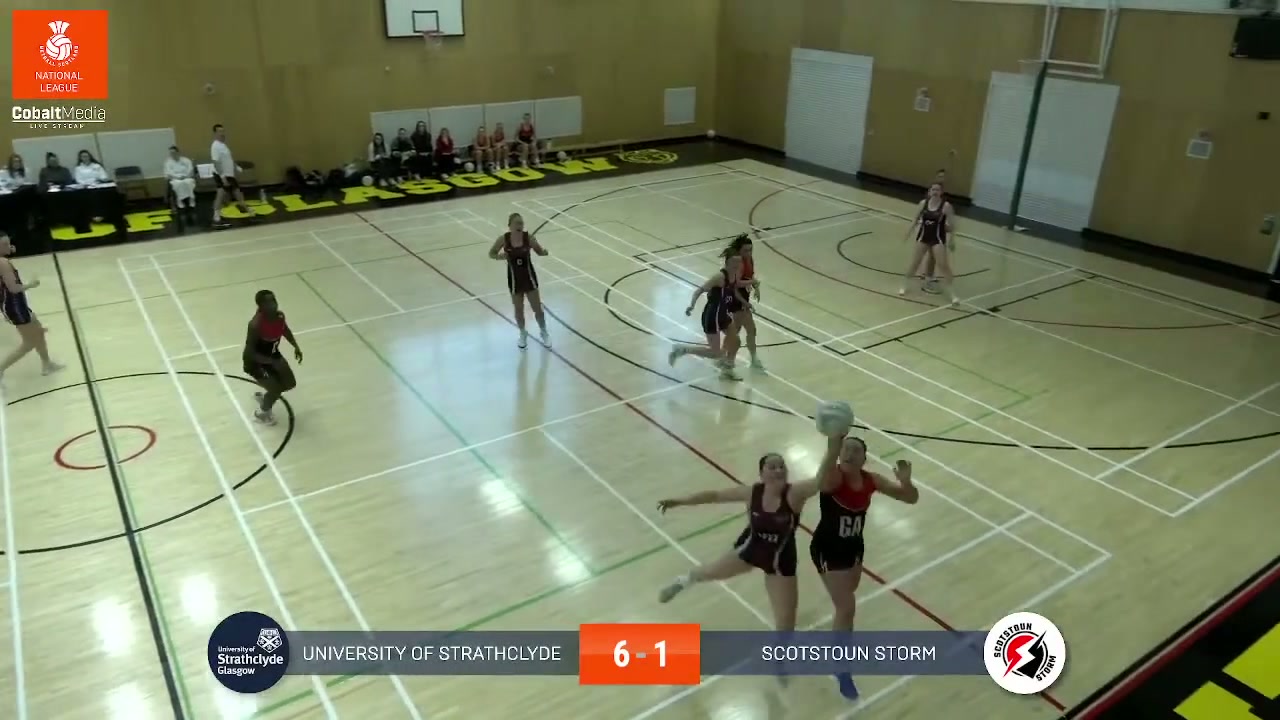
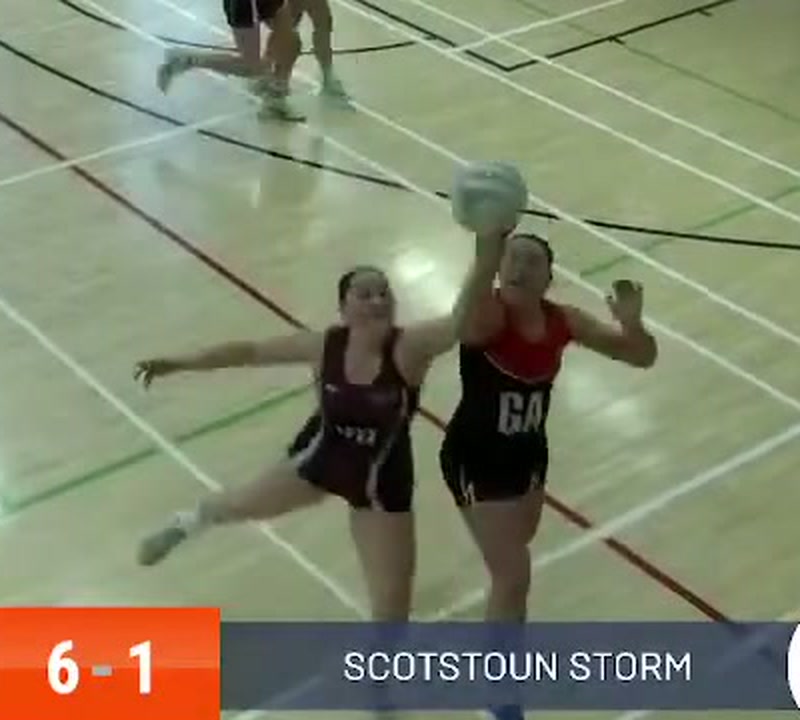
Both players reach for the ball, with the zoom showing the WD's hand in front as it's tipped away.
Whistle — contact, penalty pass to the attacking team.
The GS gains possession first, and the ball is then pulled out of her hands by the GK. That's clear interference — the contact causes the attacking player to lose the ball — and again there's no opportunity to play advantage, so the expected call is a whistle and a penalty pass for contact to the attacking team.
Rule 17 — contact.
No whistle — play on.
The GK does the hard work early: she gets herself into a strong position in front of the GS, then goes up for the ball. She tips it and then bats it to a teammate so there's no replayed ball.
There is physical contact with the GS as she goes up, but the GK has her body position in front and is making a genuine challenge for the ball. She doesn't push the GS, hold her or do anything to restrict her movement. That's a fair challenge, so there's nothing to penalise.
No whistle — play on, though this one is borderline.
The GD's contact moves the GS twice. The first movement doesn't interfere — she's shifted, but still ready to shoot from a similar position. The continuation of the contact drags her a little further and makes her slightly slower to the shot, and that's what makes this borderline. On balance, though, whistling it would be a very soft call: the drag isn't enough to meaningfully change her shooting action, so the expected decision is play on.
In open play you'd let this go comfortably, because she could still pass the ball. It's closer with a shooter: the rule doesn't change, but a shooting action has to be more precise than a passing action, so it takes less to interfere with it. Here it still falls just short.
Rule 17 — contact.
Whistle — contact by the GA, penalty pass to the defending team.
The GA and GK go up together for the rebound, and the GK clearly gains possession — she has the ball in both hands. The GA then applies pressure to the ball and to the GK's arm, and the GK drops it.
That's clear interference: the contact has caused the GK to lose possession. The expected call is contact against the GA, with a penalty pass to the defending team.
Rule 17 — contact.
No whistle — play on.
The GD and GA both go for the ball, and the GA takes the catch. The GD appears to make a light touch on the GA's hand as she does, and there's a small flinch from the GA — but she still pivots round into a position to shoot.
Imagine the touch away: she ends up in the same place, at the same time, ready to shoot. She isn't delayed getting there and isn't put off balance, so the contact hasn't interfered with her. Without interference, there's nothing to penalise.
Rule 17 — contact.
Whistle — contact against the attacking player.
Both players are running for the same space, and that on its own is a fair contest. But watch the attacking player's left arm come out and push the defending player: at that point she's interfered with her opponent's ability to defend, creating the separation through contact rather than movement. That meets the threshold for penalising, and again there's no opportunity to play advantage, so the expected call is a whistle for contact.
Rule 17 — contact.
No whistle — play on.
The GD and the WA are both moving into the same space, and there's a bit of contact as they do. But the ball is never played to either of them, and neither player gains an unfair advantage from the contact — so there's nothing to penalise. Play on.
Rule 17 — contact.
No whistle — play on, though this one is borderline.
The contact here is to the shooter's lower body. Imagine it away: the GS comes down in the same place. She isn't put off balance or made to land anywhere else, so the contact doesn't interfere with her ability to turn to post and take the shot — and without interference, there's nothing to penalise.
Rule 17 — contact affecting a shooting action.
Game management
The formal game management ladder (Rule 18.6) runs:
- Proactive advice
- Advance and/or escalate the sanction
- Warning
- Suspension
- Ordering off
Umpires normally work through the ladder in order, but a serious enough offence can enter it at any rung (Rule 18.8). The ladder only goes one way: once a player is on it, they can only receive each formal action once. The full process, with the wording to use at each step, is on the game management page.
Before entering the formal ladder, there are a number of tools an umpire can use to alert a player that their behaviour needs to change — before any formal game management action is required. Have a go at coming up with these yourself, then reveal.
- A sharper, louder whistle
- A longer whistle
- A more deliberate voice
- Sustained eye contact with the player
- Reversing the terminology order — "Goal Defence, contact" rather than "Contact, Goal Defence"
- A tactical pause before announcing the decision
These work best when you are consistent in your whistle and terminology throughout the match, so a change in whistle or flipping the terminology stands out.
Intentional infringing
Rule 19.3 is short: a player must not intentionally infringe any rule. It most commonly comes up in three scenarios:
- Intentional obstruction — a player makes no attempt to take the required distance.
- Intentional offside — a player goes offside with never any prospect of staying onside.
- Intentional contact — often better thought of as avoidable contact: if the player could have avoided it, they have effectively chosen to make it. This covers the heavy contacts that don't meet the threshold of dangerous play but were still avoidable.
Intentional obstruction and intentional offside need to be judged in the context of the skill level of the players involved. An elite-level player should have a good idea of what 0.9 m looks like: if they're stood a foot away, have time to process that, and still choose to make a defensive action, the expectation is that they knew they were too close — that's intentional. Static situations matter here too: a defender who sets up close and has time to think is in a different position from one misjudging distance on the move in dynamic play.
In a lower-division game there isn't that same expectation — the players simply don't have the same skill, perception and understanding — so you wouldn't expect to see advances for intentional obstruction in the same way. The question is always whether the player could reasonably be expected to know they were too close, and had the time to process it. The same goes for offside: did they know they were going to go offside? At lower levels a player chasing the ball often just doesn't recognise it's about to happen.
The sanction for intentional infringing is a penalty pass, advanced up to half a third. If the infringement happens in the goal third, the advance can take the penalty into the goal circle — where the shooter can take a shot.
Intentional obstruction — the sanction is advanced.
Certainly at the level of this game, this is intentional obstruction. The player is extremely close, reaches out with an arm and cynically blocks the pass — a chosen defensive action with no attempt to take the required distance. Having decided it's intentional infringing, the player is advanced.
Obstruction only — not advanced.
On first glance this can look like a clear-cut intentional obstruction — the player runs across and cynically blocks the pass. When we slow it down, though, we can see where she takes off from. The WD cuts in front of the camera at the key moment, so you can't see it exactly, but the take-off point isn't as close as it looks at full speed — probably still within 0.9 m, but there's some attempt to take distance, and this reads more as a misjudgement of exactly how far 0.9 m is.
That makes the expected decision obstruction only. It's a really hard thing to judge in real time — watched once at full speed it does look intentional, and it's only when we slow it down that the take-off distance shows.
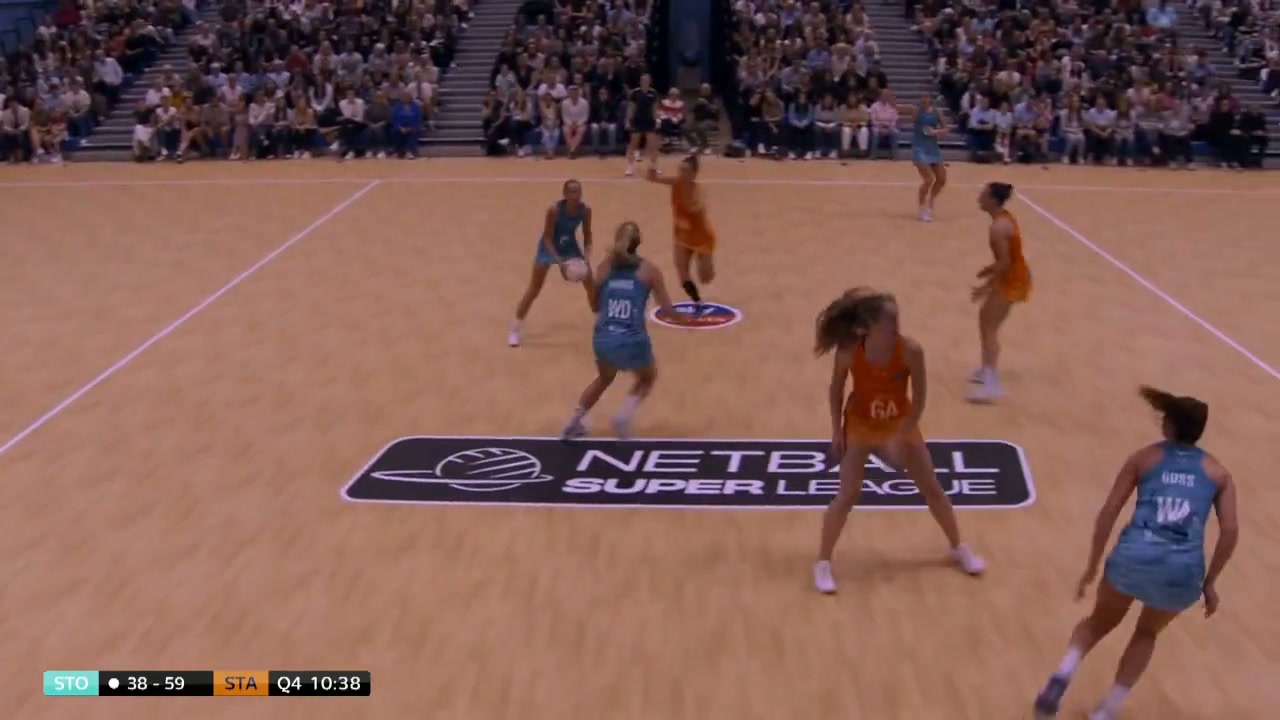
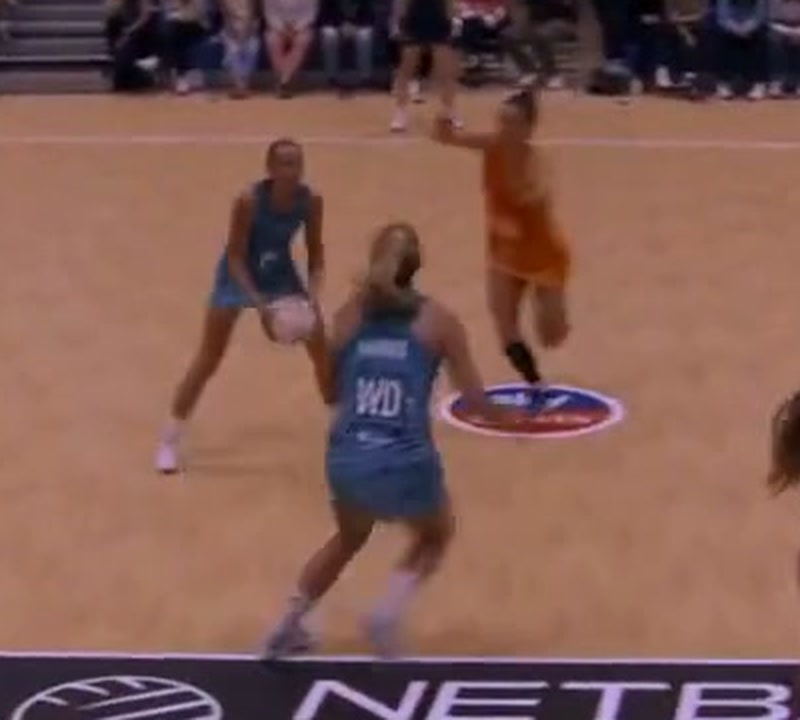
The moment the WA leaves the ground, with the zoom showing her take-off point by the centre circle — further from the thrower than it appears at full speed.
Intentional obstruction — the penalty is advanced into the circle.
The attacking C catches the ball and turns, and the defending C is stood right alongside her — nowhere near 0.9 m. She has at least a second to take in where she's standing before the pass. Then, as the attacking C goes to release the ball, she clearly raises an arm in a defensive action.
This is a high-level game. She's had time to process how close she is and still chooses to defend, so this isn't a misjudgement of the distance: it's intentional obstruction. The penalty is advanced, which here takes it into the goal circle.
Intentional obstruction — the sanction is advanced.
Again, we're at the elite level. The players are running alongside each other, very close, and there's time to think about it — she just hangs an arm out that blocks off the pass. That's intentional obstruction.
Have a look at where it happens: just inside the centre third. Then watch the end of the clip, where the umpire advances it well into the goal circle. An advance travels up to half a third, so you'd expect this one to go to around the edge of the goal circle — worth bearing in mind that when you're advancing a penalty, you don't get too carried away.
Intentional offside — advanced to a penalty by the post.
The player just runs across the goal circle. She knows she isn't going to get round and in front of the attacking player by staying onside — her route is a good foot inside the circle, and there was never any prospect of her staying onside — and she then breaks up the play by intercepting the pass. That's intentional offside, and the penalty is advanced to beside the post.
Intentional offside — advanced to a penalty close to the post.
Very similar to the last clip. The attacker has front position on the circle edge, and there's no way for the defender to get around her while staying onside — so she just goes straight through the circle and breaks up the play. There was never any prospect of staying onside: intentional offside again, advanced to a penalty close to the post.
Delaying play
Delaying play is unfair play (Rule 19.2): a player or team must not intentionally waste time or delay play. The sanction for this is a penalty pass which is advanced (Rule 19.1).
As umpires, we can be proactive in avoiding having to penalise teams for delaying play. That can be as simple as encouraging teams to get on court at the start of a quarter with an extra shout, or — if a player looks like they're being slow getting the ball back — a quick "let's hurry up, let's get the ball back", which doesn't need to reach the level of proactive advice.
You can't be repeatedly doing this, though: if players just keep delaying, you'll have to deal with it through the formal route. It all comes down to this — we don't want to be catching players out, and we don't want to be giving out game management if we don't have to. If we can be proactive and avoid that, it keeps the game going and everybody wins. That's what we want to be looking to do as umpires.
Intimidation
Intimidation is unfair play (Rule 19.6): a player, with or without the ball, must not intimidate an opponent by using behaviour designed to distract to gain an unfair advantage. The rule book's own examples include:
- covering an opponent's eyes,
- swiping the ball directly at an opponent's face,
- making unnecessary loud or sudden noises,
- stomping the ground,
- waving the arms erratically, and
- sledging an opponent.
The key question to ask here is: is the action aimed at defending? Is there a legitimate defensive purpose to it, or is its purpose to distract? Stomping the ground doesn't help you defend, block a shot or block a pass — it's only there to try to distract the shooter. That's intimidation.
The clip below is from the Commonwealth Games, and we're looking at the actions of a defender under the post.
Intimidation — a straight advance.
This is clearly intimidation. There's no defensive reason to be thrusting your head towards the shooter — it's purely there to distract — so by the letter of the rules this is an advance, and there's no real way around that. Alongside it, you could decide to manage the player with a clear piece of proactive advice: telling them they cannot do that and need to stop.
In less clear-cut cases — a defender moving their arms excessively, say — you might choose to speak to the player or their captain at quarter time to give them the heads-up, and penalise for intimidation if it continues. Particularly at our local league level, players are often unaware they're even doing it, or that they're not allowed to. We try to make them aware and give them the opportunity to change the behaviour; if they don't, we have to deal with it.
Rule 19.6 — intimidation.
Dangerous play
The 2024 rules brought a real focus on player safety, and dangerous play moved from a minimum of a warning to a minimum of a suspension. Rule 19.11 covers any action, unnecessarily forceful, careless, reckless or dangerous, that could affect another player's safety — and it names head and neck contact specifically. A player must be suspended for dangerous play, and ordered off for intentional or highly reckless acts (Rule 18.29).
The decision framework runs:
Is there a contact infringement? See above.
Does it endanger player safety? This decides whether it is dangerous play — and if it is, the minimum is a suspension.
Is it intentional or highly reckless? This decides whether the sanction is a suspension or an ordering off.
Before a suspension or ordering off: injured player first, then confer with your co-umpire. The first priority is the injured player, so check on them and bring on the primary carer if required. After a big collision there will often be an injury anyway, which gives you a natural break in the game, so use it to confer. Conferring helps in several ways:
- It gives you thinking time, letting the initial adrenaline spike pass before you decide.
- It lets the temperature of the game cool, particularly if the teammates of the injured player are upset.
- It gives you a second opinion, so you can be sure you are not doing anything too rash (or are doing too little).
- Your co-umpire knows what is coming and, if you are not bench side, can explain it to the bench (and to the reserve umpire if you have one).
The controlling umpire generally leads the conversation: say briefly what you have seen and what you intend to give, then ask whether your co-umpire has anything else or disagrees. There is more detail, with example wording, on the game management page.
Suspensions: a quick reminder
A few prompting questions on the rules around a suspension — have a think about each before revealing.
1. Can the team switch a player? If the GK is suspended, can the GD move to play GK and leave the GD position empty instead?
No — it's the suspended player's position that has to stay empty. The team plays on without a GK for the duration of the suspension.
2. What happens when the C is suspended?
The C is the exception: another on-court player must move to play C so the match can continue, and it's that player's position that stays empty instead. The process is then reversed when the suspended player comes back onto court.
3. Does the suspended player have to be the one who comes back onto court — and when can they re-enter?
No — the team can bring a substitute straight off the bench instead. Once the suspension period has elapsed, the player re-enters at the next break in play, which includes when a sanction or a throw-in is awarded, as well as after a goal or during a stoppage or interval. If you have a reserve umpire on your game, they can help manage this and make sure the right player goes back onto court at the appropriate moment.
Four rules that trip umpires up
Four rules that get called inconsistently — we break each one down below to hopefully give you a better understanding of them.
Replayed ball or repossession?
The distinction is possession. If a player had possession, released the ball and touches it again before it touches another player or rebounds from the goalpost, that is repossession (Rule 11.6). If a player never had possession and goes beyond the permitted sequence of bats and bounces, that is a replayed ball (Rule 11.7). When attempting to gain possession of the ball, a player may:
| 1st Action | 2nd Action | 3rd Action |
|---|---|---|
| Catch | — | — |
| Roll to oneself | — | — |
| Catch (from goalpost rebound) | — | — |
| Bat | Catch | — |
| Bounce | Catch | — |
| Uncontrolled touch (one or more) | Catch, bat, or bounce | |
The only time a player may make more than two contacts on the ball is when all preceding contacts were uncontrolled touches, after which the player may then catch, bat or bounce the ball.
What are the hand signals for these two infringements?
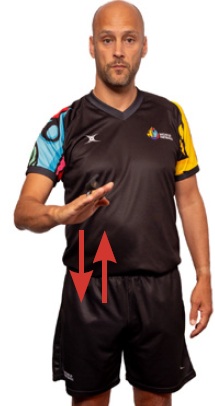
Replayed ball (incorrect playing of the ball)
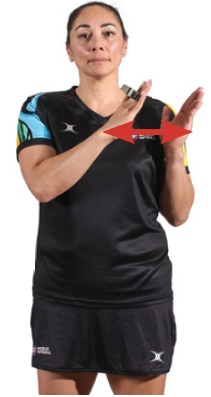
Repossession
The short pass
Rule 12.1 asks one question: when the ball leaves the passer's hands, is there sufficient space for an opposing player to deflect or intercept it on its way to the receiver?
The question to ask is: if you took a freeze frame at the moment of release and could move a defender to anywhere on court, would they have been able to deflect the ball? All they have to be able to do is get a hand in to deflect it without contacting one of the attacking players. It's important to remember it's not about where the defenders are actually standing — it's where, on that freeze frame, you could position them. And they've only got to be able to get a hand in, not their whole body.
Distance is the proxy, not the test — the speed and pace of the ball matter too. A ball thrown from quite close on a loopy trajectory can still leave time for a defender to get in and intercept it, while a ball thrown from slightly further away but drilled in hard might not. It's really the time the ball is in flight that becomes the more important factor.
There is a second, rarer case: if two team-mates gain possession in quick succession, the first to control it has to be the one who keeps it — if the second finishes with the ball, that is also a short pass (Rule 12.2).
Short pass.
The players are stood hunched over, very close together on the circle edge, and the ball travels a very small distance close to the ground — there'd be no way for a defender to get in and intercept it without contacting the players' hands or arms. The expected decision is a short pass.
Short pass — a free pass to the other team.
This is the second, rarer case from the introduction. The GA gains possession of the ball, and very quickly afterwards the GS puts her hands on it — almost simultaneous possession, but the GA was fractionally first, so she's the one who needs to end up with the ball. Instead the GS finishes in possession, so the expected decision is a short pass and a free pass to the other team. Very hard to judge in real time, and great to see the umpire getting this one right.
Rule 12.2 — simultaneous possession.
No infringement — play on.
The ball only travels about a foot, but it's a reasonably loopy pass. Take the freeze frame and move the defender: put the GD on the other side of the post and she'd quite easily be able to get a hand in to deflect the ball. The expected decision is no infringement — play on.
Contact against the defending player.
The players do end up quite close to each other — potentially within range of a short pass. But there's quite clear contact from the defending player from behind, which causes the players to become a lot closer and causes the ball to be fumbled and dropped. The expected decision is to penalise the defending player for contact.
Short pass.
Look at the position of the players at the moment the ball is passed. Between them, the two attacking players are blocking out all the space around the ball with their shoulders and arms — there's no way a defender could get in to deflect it without contacting one of them. The expected decision is a short pass.
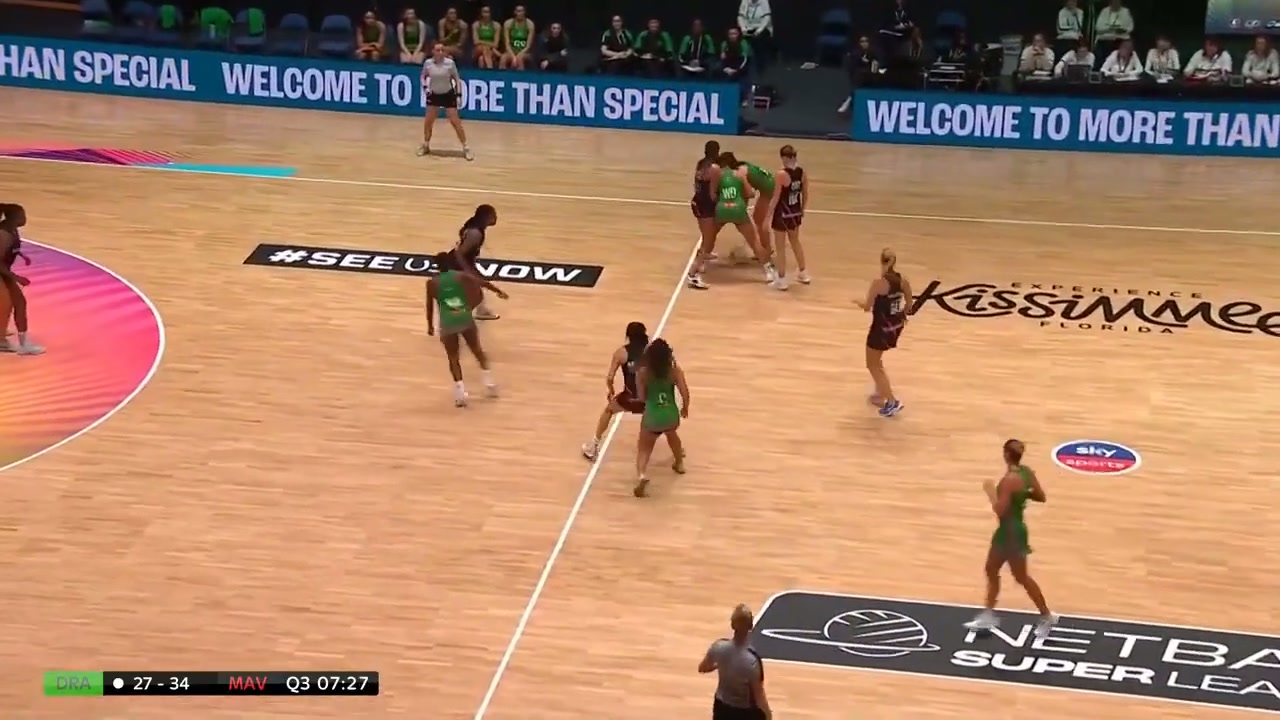
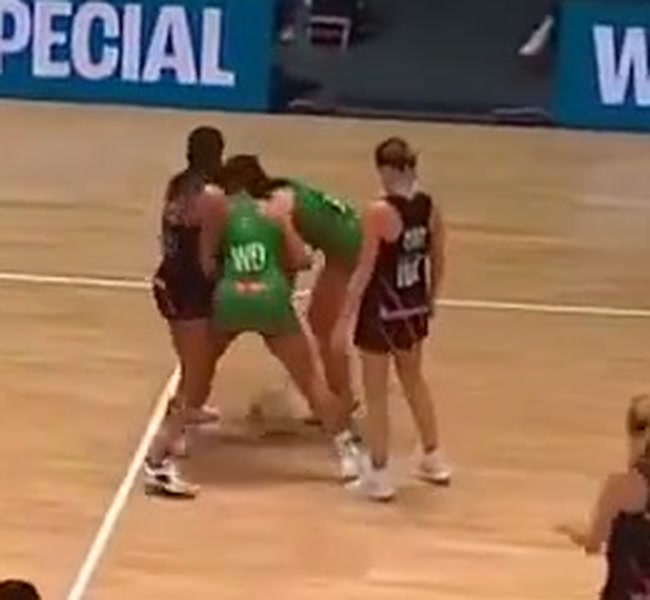
The moment the ball is passed — the zoom shows the space around the ball closed off by the players' shoulders and arms.
Footwork
Footwork is one of the most common minor infringements in the game, and it can be really hard to judge in real time when players are moving at pace. Most of it comes down to identifying the landing foot correctly.
That matters most with the late take-off, where you have to judge whether the foot was on the floor or off it when the ball was caught — and then whether that foot was regrounded before the ball had gone. Some of the clips below come down to exactly that. It is a tough call in real time, and it can be deceptive.
Pivoting: heel or toe, not both
As the rule book puts it, a pivot is "a movement where the player with the ball swivels either on the heel or on the ball of the landing foot while this maintains contact with the ground."
In other words, a player gets one pivot action — on the heel or on the toe. Something to bear in mind: if a player catches the ball with her heel raised but doesn't pivot on the toe, she can put the heel down and then pivot on the heel. She can even lift the heel again and rise onto her toe afterwards, provided there is no further pivot. You'll often see shooters doing this in the circle.
Permitted
- Land on the ball of the foot, place the heel down, then pivot on the heel
- Lift onto the ball of the foot afterwards, with no further pivot
- Land flat-footed and pivot on the heel only, or the ball of the foot only
Footwork
- Pivot on the toe, ground the heel, then pivot on the heel — two pivot points
- Alternate heel and toe to gain ground: the shuffle
- Any movement that uses two pivot points
What is the hand signal for footwork?
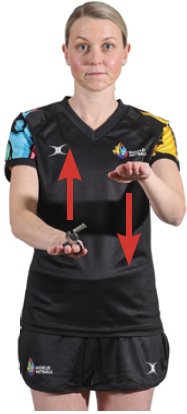
Footwork
No whistle — play on.
The GS catches on the ball of her foot with the heel raised, places the heel down, and only then swivels — on the heel. There's no turn on the ball of the foot before the heel goes down, so there is one pivot point, and that's permitted. It can look like a shuffle, which would lead to an incorrect whistle, but there is no pivot on the toe first, and the umpire correctly identifies that there is no infringement.
Rule 13 — footwork, and the definition of a pivot ("either on the heel or on the ball of the landing foot").
Whistle — footwork, free pass to the defending team.
The GS lands on both feet, then pivots on her right foot, so that is the landing foot. Before the ball leaves her hands she lifts it, steps back with it and puts it down again — the landing foot is regrounded before the pass, and that's footwork. The slowed-down view below runs the feet and the hands side by side, so you can see where the foot is at the instant the ball leaves. A great spot by the umpire in real time.
Rule 13.1 — the ball must be released before the landing foot is regrounded.
Whistle — footwork, free pass to the defending team.
When the WD catches the ball her right foot is still on the floor. She then lifts it and regrounds it before the pass, which is footwork. The catch looks awkward, and that should put you on high alert: as the ball arrives she is still pushing up off her right foot, trying to get off the ground. That is the sign that she couldn't get airborne before taking the ball, and it should help you pick out the footwork.
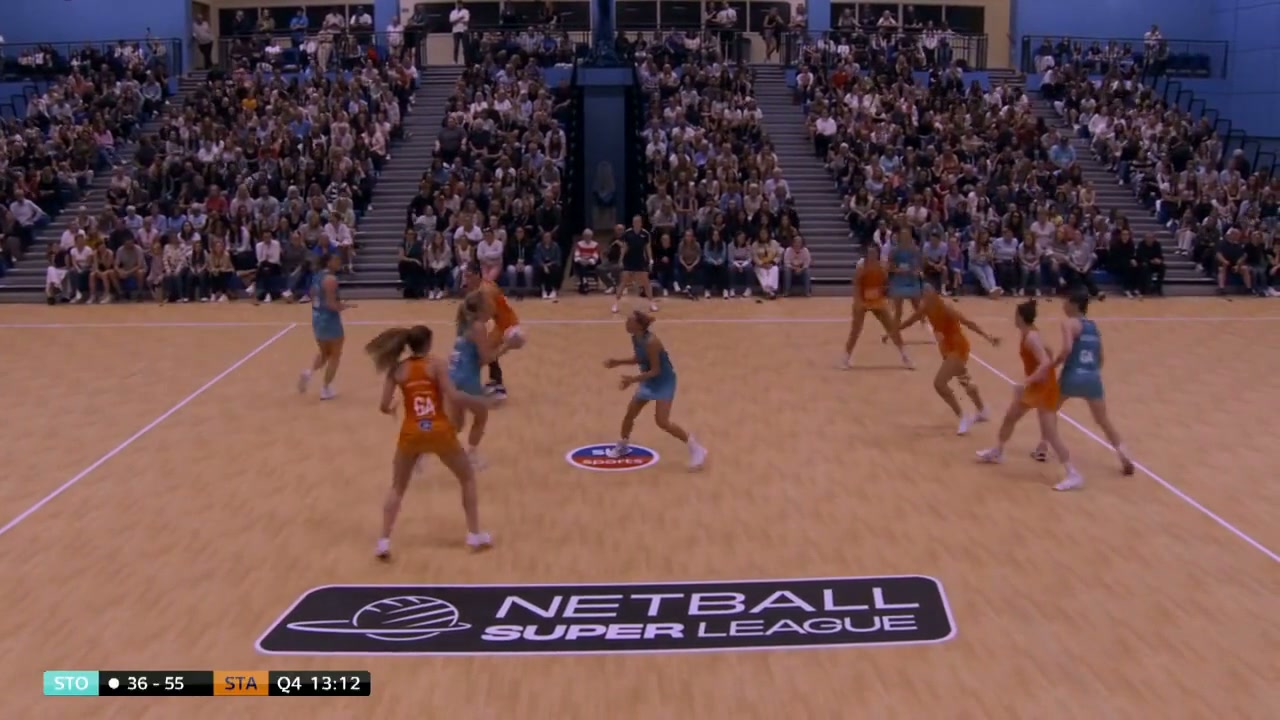
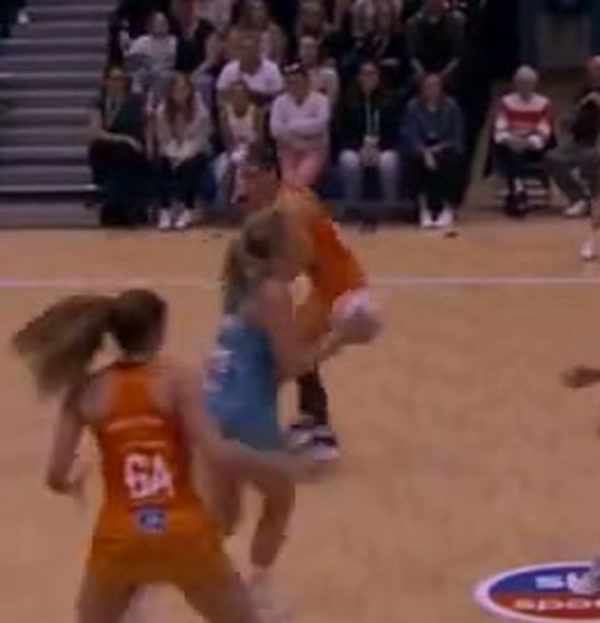
The ball is in both hands and the right foot is clearly still on the floor — that is her landing foot.
Rule 13.1 — a player who receives the ball with one foot on the ground has that foot as the landing foot.
Whistle — footwork, free pass to the defending team.
At full speed she looks to be in the air when she takes the ball, but the frame at the catch shows her right foot is still just on the floor as the ball reaches her hands — a late take-off. That right foot is her landing foot; she jumps from it and it is back on the floor before the ball is released, so the landing foot has been regrounded and it's footwork. A really good spot in real time by the umpire, and it shows how fine the margins can be.
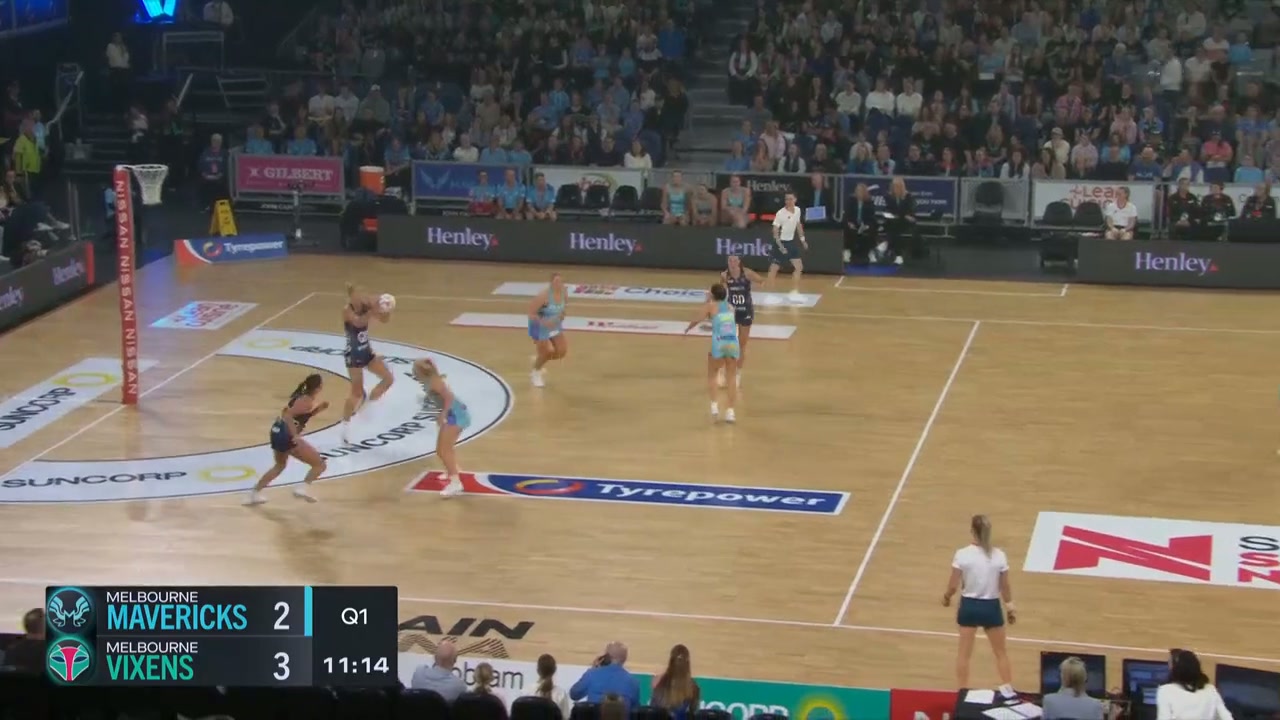
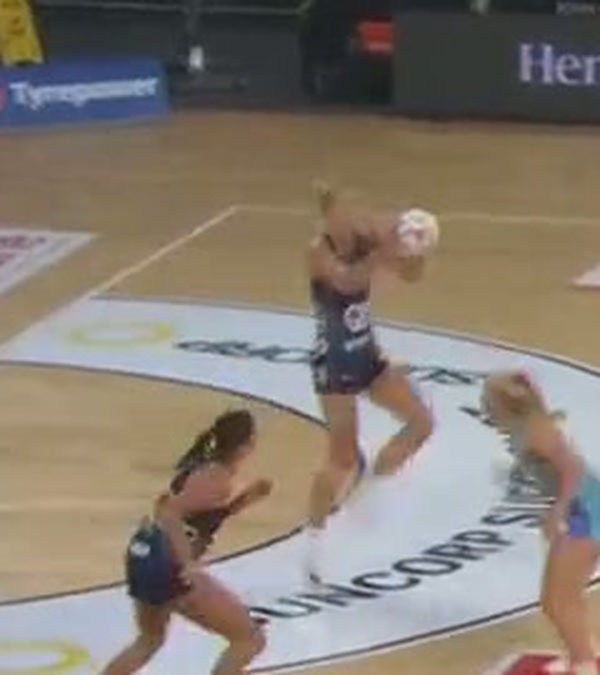
The instant the ball arrives — the zoom shows the right foot still on the floor, so it is her landing foot.
Rule 13.1 — after catching the ball in the air, the first foot to land is the landing foot.
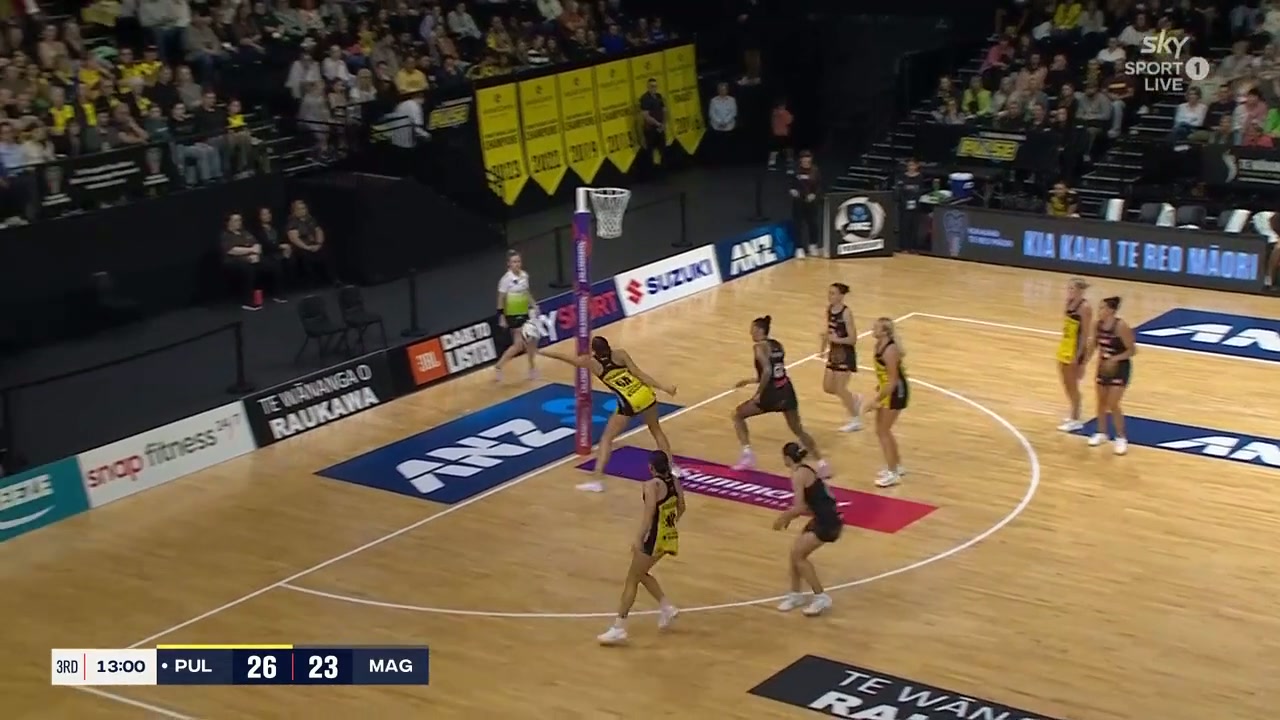
Whistle — footwork, free pass to the defending team — but it depends on when you view her as having possession.
At full speed this looks like a one-foot landing on the left with the right in the air, a step onto the right, and a pass — nothing to give. The stills tell a different story. As the ball first arrives it is on one hand, and her right foot is still on the floor. Possession in the rules is holding the ball with one or both hands, so on that reading the right foot is her landing foot, and when it comes down again before the pass, it has been regrounded: footwork. If you view her as gaining possession a fraction of a second later, her right foot is in the air, so it wouldn't be footwork. This shows how hard it is to get these decisions right in real time.
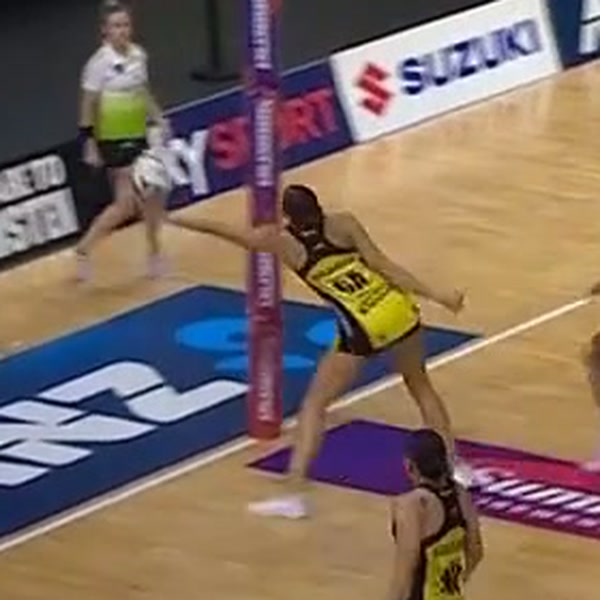
Ball on one hand, right foot on the floor
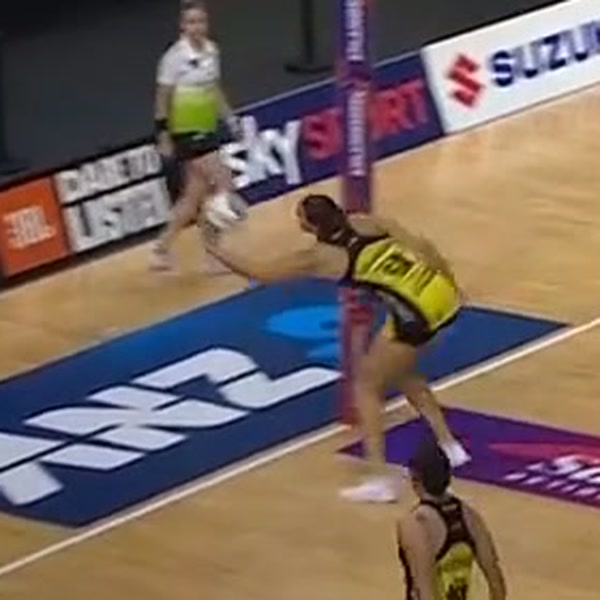
0.14 s later
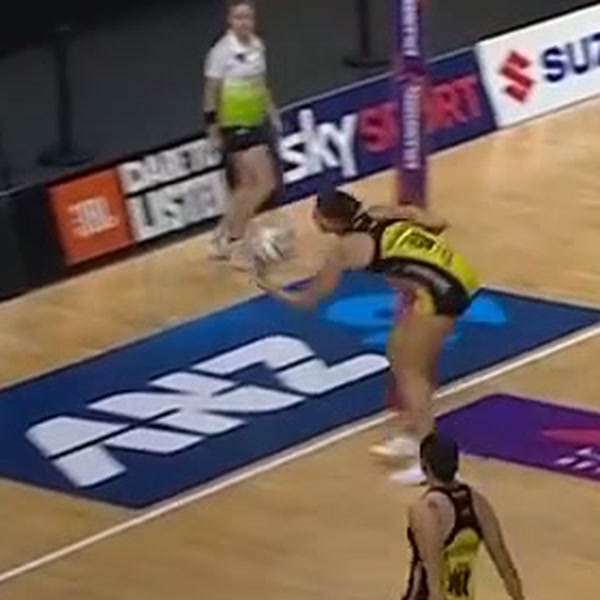
0.2 s later
Rule 13.1 — a player who receives the ball with one foot on the ground has that foot as the landing foot; possession is holding the ball with one or both hands (definitions).
Using the goalpost
A player may not use the goalpost as a support, including to gain or retain possession of the ball (Rule 11.3). Incidental contact with the post is nothing — posts get brushed constantly.
What is the correct hand signal for using the goalpost, and for interference with a shot?
Using the goalpost (incorrect playing of the ball)
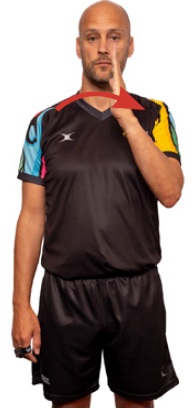
Interference with shot
Case study: from suspension to ordering off
Ordering offs don't happen often, so it's worth studying one in case it ever comes up in one of your games. This case study takes a match from the recent World Cup qualifiers held in Scotland and follows one player from a suspension to an ordering off, with clips of each step and the procedures that follow.
Keep going
There's a lot more content on the rest of this site that goes into a lot more detail. Click the buttons below to view some of it and build up your rules knowledge even further.
Questions about anything in this session, or something you'd like to see covered?
Get in touch