Rule 15: Out of court
Rule 15 covers when the ball and players are considered out of court, and the consequences of leaving the court or defending from out of court. While the core principles are intuitive, there are several situations — particularly around re-establishing on court and defending near the boundaries — where the detail matters.
Ball Out of Court
When the ball goes out of court, a throw-in is awarded to the team that did not touch the ball last on court. The phrase "on court" is important and leads to some specific interpretations worth understanding.
Last Touch "On Court"
The throw-in is determined by the last player to touch the ball while on the court. This means that if an opposing player is fully off the court and catches or touches the ball, the throw-in is still awarded against that player's team — their touch does not count because they were not on court when they made contact with the ball.
Objects Outside the Court
The ball is out of court when it touches any person or object that is in contact with the ground outside the court. This applies even if the ball is over the court at the point of contact. For example, if a basketball hoop at the edge of a shared facility overhangs the playing area, the ball hitting that hoop is out of court — because the hoop's base is in contact with the ground outside the court.
Lines and Boundaries
The ball is not out of court when it lands on but not over any part of the goal line or side line. The same principle applies to players — a player is not out of court if any part of their body is on but not over the line.
Goalpost Rebounds
The ball is not out of court if it hits the goalpost and rebounds back into the court. However, be aware of the type of goalpost in use. Some goalposts have a larger base that sits off the court or on the goal line. If the ball hits that base, it is out of court — the base is an object in contact with the ground outside (or on the boundary of) the court.
Re-establishing on Court
A player who has any contact with the ground outside the court must re-establish themselves back on court before playing the ball. To re-establish, the player must touch an on-court area and have no contact with the ground outside the court. If they play the ball before re-establishing, it is treated as out of court and a throw-in is awarded to the opposing team.
Throw-In Off the Goalpost
A common scenario to watch for is a GS or GK playing a throw-in off the goalpost. After releasing the ball, the player must re-establish themselves back on court before gathering it. Check both that they have re-established and that the short pass rule has been complied with — the ball must travel sufficient distance for an opponent to be able to deflect it on its path from the thrower, to the post, and back again.
Shooter Repositioning via the Goal Line
You will sometimes see a shooter run off the court via the goal line in order to reposition themselves within the goal circle. This is permitted (see Leaving the Court below for the rules on this), but the player must re-establish themselves back on court before they can receive a pass. If a teammate passes to them before they have re-established, the ball is out of court.
Jumping from Court
A player may jump from a position inside the court and pass or shoot the ball before landing outside the court. This is permitted because the player has not yet made contact with the ground outside the court at the point of releasing the ball — no re-establishment is needed.
Leaving the Court
A player who does not have contact with the ball — whether attacking or defending — may move into the court surround, but solely for the purpose of repositioning back onto the court. If a player leaves the court for any other reason, they should be penalised.
Consequences of Leaving the Court
If a player leaves the court for a reason other than repositioning — for example, to retrieve a drink from the bench — they are penalised for "Leaving the court". The sanction is a penalty pass on court in line with where the player left. Advantage may also be played.
Once penalised, the consequences go further. The player is then treated as a late player: they cannot re-enter the court until a break in play (they can enter at a break as, by definition, their position will be vacant). If they re-enter before a break in play, they should be penalised for incorrect entry and sent from the court, with possession awarded to the opposing team.
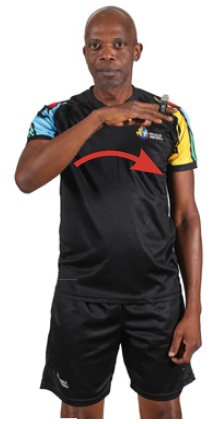
Leaving the Court Signal
Defending from Out of Court
A player standing outside the court may not attempt to defend a player on the court, whether or not that player has the ball. This includes restricting an opponent's movement or extending an arm to try to block a pass or shot. The sanction is a penalty pass on court near where the infringer was standing.
Not Permitted
- Defending any on-court player while standing off court
- Restricting an opponent's movement while off court
- Extending an arm from off court to block a pass or shot
Permitted
- Defending an attacker who has gone off court, provided the defender remains on court
- Going off court to reposition, including following an attacker who is repositioning off court (but no defensive action while off court)
- Preventing an attacker who left the court to reposition from re-entering the court (subject to obstruction and contact rules)
Jumping from Off Court
A player who is off court and jumps into the air — for example, to try to block a shot — is still defending from out of court. In the same way that a player must re-establish themselves on court before playing the ball (otherwise it is out of court), they must re-establish themselves on court before taking any defensive action. Being airborne does not count as being on court.
Right to Re-enter the Court
An attacker who leaves the court to reposition has no right to be allowed back on court. A defender — subject to the rules above and the usual obstruction and contact rules — can try to prevent them from re-entering.
The situation is different for a player who has gone to retrieve the ball or who has taken a throw-in. These players must be allowed to re-enter the court — but only at the point where they left it. If they attempt to re-enter at a different point, a defender is within their rights to try to prevent this.