Rule 13: Footwork
Footwork is a common infringement at lower levels of netball, and we still see it even in high-level games — though it tends to become more subtle. Being aware of the landing foot is key not just to correctly penalising footwork, but also to other infringements like obstruction and over a third.
The sanction for all footwork infringements is a free pass where the infringement occurred.
Understanding the Landing Foot
Everything in the footwork rule flows from identifying the landing foot. The landing foot determines which foot a player can pivot on, which foot must be released before regrounding, and where measurements such as obstruction distance are taken from.
One-Foot Landing
Where a player lands with one foot first and then the other, the first foot to land is the landing foot. This also applies if a player is already standing on one foot when they catch the ball — that foot is the landing foot.
This is the most common type of landing and produces the widest range of movement options.
Two-Foot Landing
Where a player catches the ball while both feet are on the ground, or lands on both feet simultaneously, the landing foot is the foot not first moved.
In practice, the landing foot only becomes defined once the player chooses to move one foot or pivots on one foot. From that point on, the rules are equivalent to a one-foot landing.
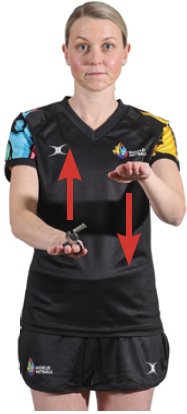
Footwork Signal
One-Foot Landing Options
After a one-foot landing, the player has several options for how they can move before releasing the ball. The constant across all of these is that the ball must be released before the landing foot is regrounded.
| What the Player Does | Key Constraint |
|---|---|
| Step with the other foot, then lift the landing foot | Must release the ball before regrounding the landing foot |
| Pivot on the landing foot and step with the other foot (one or more times) | May lift the landing foot, but must release before regrounding it |
| Jump from the landing foot onto the other foot, then jump again | Must release the ball before regrounding either foot |
| Step with the other foot, then jump | Must release the ball before regrounding either foot |
An important point to note is that while a player may step with the non-landing foot and lift the landing foot, and may also jump off the non-landing foot, they cannot pivot on the non-landing foot. The only foot a player may pivot on is the landing foot.
The Layup
One slightly unusual technique you may see from shooters, taking influence from basketball, is the layup. A shooter catches the ball in the air, lands on one foot (the landing foot), steps onto the other foot, and then jumps off that foot to shoot — releasing the ball before regrounding either foot.
What Is a Pivot?
The pivot is one of the most important movements to understand when assessing footwork. The rule book defines it as:
"A movement where the player with the ball swivels either on the heel or on the ball of the landing foot while this maintains contact with the ground."
The word "either" is critical. A player must pivot on the heel or on the ball of the foot — they cannot switch between the two. Once a player has started pivoting on one part of the foot, they have committed to that pivot point for the duration of the movement.
The Shuffle
The most common place you will see the "either" restriction tested is with shooters attempting to shuffle closer to the post. A shooter may try to pivot on the ball of their foot (turning their heel inward) and then switch to pivoting on their heel (turning their toe inward) to gain a few extra centimetres towards the goalpost.
Heel Placement After Catching
The key principle here is that a player may only have one pivot point. A player may catch the ball with their heel raised (i.e. on the ball of their foot). They can then place their heel on the ground and subsequently pivot on the heel — provided there was no turning on the ball of the foot while the heel was raised. No pivot has yet occurred; the player has simply placed their foot flat. The pivot only begins once they start swivelling on the heel.
This principle extends further. A player who has pivoted on their heel may transition onto the ball of their foot — and this is permitted, as long as they do not then pivot on the ball of the foot. The infringement occurs only when a player pivots on more than one contact point. This is what distinguishes a permitted transition from the shuffle described above.
Permitted
- Land on ball of foot, place heel down, pivot on heel
- Pivot on heel, then transition to ball of foot (no further pivot)
- Land flat-footed, pivot on heel only (or ball of foot only)
Infringement
- Pivot on ball of foot, then pivot on heel (or vice versa)
- Alternate between heel and toe pivots to gain ground — this is the shuffle
- Any movement where two pivot points are used
Two-Foot Landing Options
In a two-foot landing, the player has both feet on the ground and must choose how to proceed. As soon as they lift one foot or pivot on one foot, the other foot becomes the landing foot — and from that point on, the options are the same as for a one-foot landing.
The one distinct option available only from a two-foot landing is that a player may jump from both feet and land on one foot. The foot they land on then becomes the landing foot, and they must release the ball before regrounding the other foot. This effectively converts a two-foot landing into a one-foot landing situation.
Practical Scenarios to Watch For
Beyond the core footwork rules, there are several specific scenarios where footwork infringements are more likely to occur or where the application of the rule requires particular awareness.
Extension Catches and Dragging
When a player catches the ball at full stretch — reaching out to intercept or collect a wide pass — pay extra attention to their landing foot. The momentum of stretching for the ball makes it much more likely that the player will drag or slide the landing foot as they bring themselves back into balance. This is one of the most common footwork infringements and can be subtle, so watch the landing foot closely on any extension catch.
Lifting the Landing Foot on Release
A player who overextends when passing, or who decides to fake a pass at the last moment, may momentarily lift the landing foot slightly and then reground it before actually releasing the ball. This is footwork. It can be very subtle — a brief lift and reground that happens in a fraction of a second — but if the landing foot leaves the ground and is regrounded before the ball is released, it must be penalised.
Falling to the Ground
While a player cannot play the ball on the ground, if they gain possession of the ball while standing and then fall over, they are not immediately penalised. They must regain their feet and continue to obey the footwork rule before passing or shooting. Crucially, the player must not reground the landing foot while getting up — if they do, it is a footwork infringement.
Shooter Stepping In and Tapping the Landing Foot
When a shooter steps onto the non-landing foot to move closer to the post, they may lose balance slightly and tap the landing foot down before releasing the ball. This is footwork — the landing foot has been regrounded. It is particularly common when shooters are trying to step in quickly under pressure from a defender, as the momentum of the step can make it difficult to hold the landing foot off the ground. Watch the landing foot closely any time a shooter steps in to shoot.
The Layup Revisited
As discussed in One-Foot Landing Options, the layup is a fully permitted technique. Be prepared for it — particularly at levels where players have basketball backgrounds — and do not penalise what may at first glance look like an unusual movement.