Rule 12: Passing distances
Rule 12 covers short pass and over a third—simple rules in principle, but with important nuances, especially in the application of short pass.
Short Pass: The Rule Explained
The short pass rule has evolved over the years. Let's break down the current version to understand exactly what it requires:
| When a player passes the ball | A pass involves throwing, batting, bouncing the ball, or even dropping and placing the ball on the ground. |
| there must be sufficient space on the court | The key phrase here is on the court. This is particularly relevant for throw-ins or passes close to court edges (usually the goal line). |
| for an opposing player to be able to deflect or intercept the ball | Note the opponent does not need to be able to catch the ball—simply to deflect it, which could be done with an extended arm. |
| as it moves from the hands of the passer to the receiver | An opponent must be able to deflect the ball at some point along its trajectory between passer and receiver. |
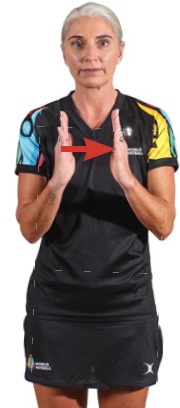
Short Pass Signal
Judging a Short Pass
When assessing a potential short pass, you need to consider both space (where an opponent could position themselves) and time (whether they would have enough time to react).
Space: Where Could an Opponent Stand?
There just needs to be somewhere on court that an opponent could stand in order to deflect the ball—there does not have to be an opposing player actually standing there.
Consider a freeze-frame moment at ball release: if you could position an opposing player anywhere on court to deflect the ball, there is no infringement.
Key point: This may not be the defender marking the passer. For example, if a pass between a C and WA on circle edge could not be deflected by the opposing C/WD (who are shielding on circle edge) but could be intercepted by a GD/GK standing inside the circle, this is not a short pass.
Time: More Important Than Distance
The time the ball is in flight between the hands of the passer and receiver is more important than the distance travelled.
A ball drilled into the receiver's hands gives much less opportunity for an opponent to deflect versus a loopy pass, even if over a short distance. We are assessing whether an opponent positioned correctly would have time to react and deflect before the receiver catches it.
Common Short Pass Situations
A short pass is generally called in two situations:
The ball travels an extremely short distance between the hands of the passer and the receiver (or even is just handed from one player to the other), and there simply is not sufficient time for an opponent to deflect it.
Two players standing very close to each other (usually on circle edge) are shielding a space between them so no opposing players can access this space without making contact. They then put a short bounce pass (or place the ball on the floor) between them. Even though the ball may be in flight for enough time where an opponent could react, there is no way for an opponent to access this ball without contacting the players.
Important note: If the ball can be accessed from one angle (even if this is not where an opponent is currently standing, or would require a different opponent as the current defender would be offside), this is permitted—it only becomes a short pass if there is no way an on-court opponent could have accessed it.
Specific Scenarios to Watch For
Throw-ins and Goal Line Passes
When assessing passes from a throw-in or close to the goal line, it is critical to consider the on court part of the rule.
Ball Off the Post
World Netball has clarified how the rule should be interpreted where a player passes the ball to themselves off the post:
World Netball Clarification:
"As the player is both passer and receiver, there must be sufficient space on the court for an opposing player to be able to deflect or intercept the ball, as it moves from the hands, to the post, and back to the hands of the same player again."
This means we judge the complete action, not just the initial throw to the post. A player could throw the ball a very short distance against the post, provided it then travels a sufficient distance from the post before regathering that an opponent could have intercepted it.
Quick Succession Possession
A specific scenario described in the rules is where two players from the same team gain possession of the ball in quick succession.
The player who gained possession of the ball second must quickly remove their hands, otherwise it will be ruled a short pass.
Positioning to Judge Short Pass
Positioning is key when judging a short pass. You need an open view of both the passer and receiver so you can see both the trajectory of the ball and any space around them where an opponent could be positioned.
Key Positioning Principles
- Try to avoid being too square on the sideline. You never want to be directly in line with the two players as you'll be looking through a player's back (in the same way you don't want this angle for judging obstruction).
- It is important to move to the goal line quickly when the ball is on circle edge so you don't find yourself in a similar awkward position where you are looking through the backs of players to see the trajectory of the pass.
- On the goal line, be active making sure you can always see the circle edge players as well as the players on the edge of the circle.
- Without good positioning, you can end up missing a quick pass out and in and not be sure whether this was short.
Over a Third: Core Requirements
The over a third rule is relatively straightforward: the ball must be touched by a player in each third of the court.
Key Points to Consider
- The player who touches the ball must either be standing wholly within the third concerned (noting transverse lines form part of either third) OR must land with their first foot wholly within the third.
- If a player catches the ball with feet astride the transverse line, the next pass must be caught within one of the two thirds they are standing across.
- After catching the ball, a player can pivot or step (provided they abide by the footwork rule) into an adjacent third. The pass is still considered to be made from the original third they were standing in.
- For a goal line throw-in, the ball must be caught in the adjacent goal third.
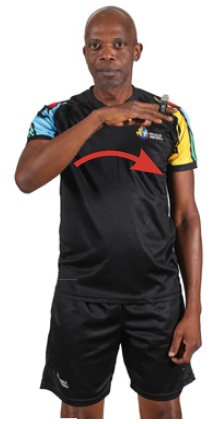
Over a Third Signal
Applying the Sanction
It is usually clear which team should be awarded the free pass. However, the rule book doesn't actually state this explicitly, which can create ambiguity in certain situations.
Ambiguous Scenario
Scenario: A blue GK passes the ball from the goal third. The ball brushes the fingers of the red GS who is defending, and then sails over the centre third into the other goal third.
The blue GK is the passer but the red GS touches the ball last—so who should be awarded the free pass?
The rule talks about a pass being touched, which suggests the responsibility is on the team of the passer to ensure it is touched in each third. The interpretation we take is this means the free pass would be awarded against the blue GK (as the passer) and to the red team.
Umpiring Over a Third
Playing Advantage
It is reasonable to play advantage for over a third if the ball is caught by the non-infringing team close to the transverse line where the free pass would be taken.
- Make this a loud and clear call with accompanying hand signal.
- Players sometimes do not expect this (even at high levels) and may be expecting a whistle and free pass.
- If players proceed to walk to take the free pass despite advantage being called, they will be penalised for the resulting footwork infringement. Clear communication from the outset helps avoid this situation.
Co-umpire Collaboration
It is important to be alert about which third the ball has been released from when it is in your co-umpire's half.
- It is easy to not be focusing on the movement of players within your controlling half and realise as the ball sails into the goal third that you're not actually sure which third it was passed from.
- If you find yourself uncertain, a glance to your co-umpire may provide confirmation.
- As the non-controlling umpire, be ready to assist your colleague—a quick thumbs up or small over a third hand signal can be greatly appreciated.
Rare Scenarios
One rarer situation that you need to be alert to is where the ball is when a ball is thrown back into the centre third by an attacking team and is missed by everyone.
If this ball then bounces back into the other goal third without being touched, this would be over a third. You may consider playing advantage here if it is caught by a player from the non-infringing team.