Rule 11: Playing the ball
Rule 11 covers how players may gain possession of the ball, what they can and cannot do with it, and the three-second held ball rule. While many of the sub-rules are straightforward, there are several areas that benefit from closer discussion.
The sanction for all infringements under this rule is a free pass where the infringement occurred.
Gaining Possession
When attempting to gain possession of the ball, a player may:
| 1st Action | 2nd Action | 3rd Action |
|---|---|---|
| Catch | — | — |
| Roll to oneself | — | — |
| Catch (from goalpost rebound) | — | — |
| Bat | Catch | — |
| Bounce | Catch | — |
| Uncontrolled touch (one or more) | Catch, bat, or bounce | |
Note that the only time a player may make more than two contacts on the ball is if all preceding contacts were uncontrolled touches, after which the player may then catch, bat, or bounce the ball.
Bat, Bounce, or Uncontrolled Touch?
- A bat or bounce is a single, instantaneous impact on the ball. If a player scoops or directs the ball in a sustained motion, this should be viewed as the player having played the ball — in effect, they have had possession and cannot play it again.
- When assessing whether a touch is uncontrolled (as opposed to a bat or bounce), consider whether the player had the ability to direct the ball in the way they wanted. Factors to consider include:
- The skill level of the players
- How much the player is reaching or stretching for the ball
- Whether they are contesting with another player
Rolling the Ball to Oneself
This is listed as a legal method of gaining possession, but it is important to remember the context: it applies to gaining possession of a loose ball. For example, a player might reach out for a ball on the floor and roll it towards themselves before picking it up.
Replayed Ball vs Repossession
These are two distinct infringements that are sometimes confused. The simplest way to distinguish them is to consider whether the player had possession of the ball before the infringement occurred.
Repossession
A player who had possession of the ball (i.e. was holding it), releases the ball — whether intentionally or unintentionally — and then touches it again before it has been touched by another player or the goalpost.
Key point: The player had the ball and let go of it.
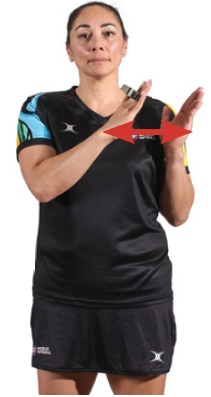
Repossession Signal
Replayed Ball
A player who did not have possession plays the ball in a way that exceeds the permitted combinations of bat, bounce, and uncontrolled touch.
Key point: The player never held the ball.
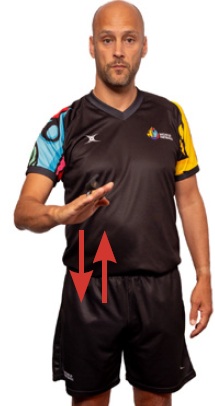
Replayed Ball Signal
Examples
| Scenario | Infringement? | Terminology |
|---|---|---|
| A player bats the ball to a teammate | No | Permitted |
| A player bats the ball, then bats it again to a teammate | No | Permitted (bat then bat to another is permitted) |
| A player bounces the ball three times | Yes | Replayed ball |
| A player touches the ball in an uncontrolled manner, then bats it in a controlled manner, then catches it | Yes | Replayed ball |
| A player takes a shot which misses everything, and the same player catches it again | Yes | Repossession |
| A player is holding the ball and drops it, then bats it to a teammate | Yes | Repossession |
| A player passes the ball, a defender deflects it, and the original player catches it again | No | Permitted (another player touched the ball) |
| A player shoots, the ball rebounds off the goalpost, and the same player catches it | No | Permitted (ball touched the goalpost) |
Held Ball
A player in possession of the ball must release it within 3 seconds. On the face of it this is a simple rule, but in a busy and fast-paced game it can be surprisingly difficult to track consistently. It is important that every time a player gains possession, you are actively acknowledging the moment they take the ball and using this to count the 3 seconds.
Developing Your Count
When starting out, many umpires find it helpful to count internally — for example, "one elephant, two elephant, three elephant" (or any consistent phrase of roughly one second) — each time a player catches the ball. With experience, this becomes more intrinsic and you develop a reliable feel for 3 seconds without actively counting.
It is however always good to calibrate from time to time, even as an experienced umpire. A simple exercise is to practise with a stopwatch to check your internal count is accurate.
Another approach is to find a song with a tempo of either 60 BPM (where 3 beats = 3 seconds) or 80 BPM (where 4 beats = 3 seconds) and use this to set your rhythm. For example, Under the Bridge by the Red Hot Chili Peppers has a tempo of just over 80 BPM, so counting one bar of four beats is roughly 3 seconds. This can be a good way to get yourself in the zone before a match and recalibrate during breaks.
Common Pitfalls
- Don't be influenced by a player's demeanour. It is easy to incorrectly whistle for held ball simply because a player looks panicked — and conversely, to give a calm player more than 3 seconds. Always rely on your own count, not how the player appears.
- Don't let the pace of the game speed up your count. In fast, frantic passages of play, or when there is a loud crowd, there is a natural tendency to rush. Be aware of this, particularly in close games, and make sure your 3-second count remains consistent.
Prohibited Actions
Rule 11 explicitly prohibits several ways of playing the ball. All result in a free pass.
Playing the Ball on the Ground
There are two related but distinct rules about playing the ball while on the ground:
Playing ball on ground
A player cannot fall on the ball to gain possession, or gain possession while lying, sitting, or kneeling on the ground. This concerns the act of gaining possession.
Incorrect playing of the ball
A player cannot pass or shoot while lying, sitting, or kneeling on the ground. This concerns what a player does after having gained possession.
Kicking
"Kick" is not defined in the rules, so we look to a dictionary definition: a physical strike with the foot, leg, or knee. When assessing whether something is a kick, what you are looking for is movement of the foot or leg towards the ball that strikes the ball, whether intentional or not.
- A kick requires motion of the foot, leg, or knee towards the ball. The ball simply hitting a stationary foot, or a foot that is moving away from the ball, would not be considered a kick.
- A kick does not need to be intentional. If a ball is bouncing around a player's feet and their foot moves into the ball and strikes it, that is a kick — regardless of whether the player meant to do it.
Striking with a Fist
A player must not strike the ball with a closed fist. An open-palmed bat or deflection is legal.
Rolling to Another Player
A player must not roll the ball along the ground to another player. This is distinct from rolling the ball to oneself, which is a legal method of gaining possession (see Gaining Possession above).
Using the Goalpost
A player may not use the goalpost as a support. This applies to all players, whether or not they are in possession of the ball.
Using as Support (Infringement)
- Leaning on the goalpost to maintain balance or delay falling over
- Bracing against the goalpost to prevent going off court
- Holding the goalpost to steady oneself, including while positioning for a rebound
Incidental Contact (Not an Infringement)
- Brushing against the goalpost during normal movement
- Bumping into the goalpost, provided it has not been used as a support
- Touching the goalpost without gaining any advantage from it
The rule gives the example of using the goalpost to gain or retain possession, but it covers all circumstances — including when a player does not have the ball. For instance, a teammate of the shooter who uses the goalpost as a support while positioning for a rebound would be penalised, and the shot would not count.
Note that "contact on the post" is not a term found in the rule book — it is either using the goalpost (free pass, under this rule) or interference with the shot (penalty pass, under Rule 9), and it is important to use the correct terminology.
Key Terminology Summary
Rule 11 introduces several specific terms. Using the correct terminology in your calls helps players understand the infringement and demonstrates competence.
| Term | Meaning |
|---|---|
| Held ball | Player in possession for more than 3 seconds |
| Repossession | Player touches the ball again after releasing it, before another player or the goalpost touches it |
| Replayed ball | Player without possession plays the ball in a way that exceeds the permitted combinations |
| Playing ball on ground | Gaining possession while lying, sitting, or kneeling, or falling on the ball |
| Incorrect playing of the ball | Passing or shooting while lying, sitting, or kneeling, or kicking, striking with a fist, or rolling to another player |
| Using the goalpost | Using the goalpost as a support |